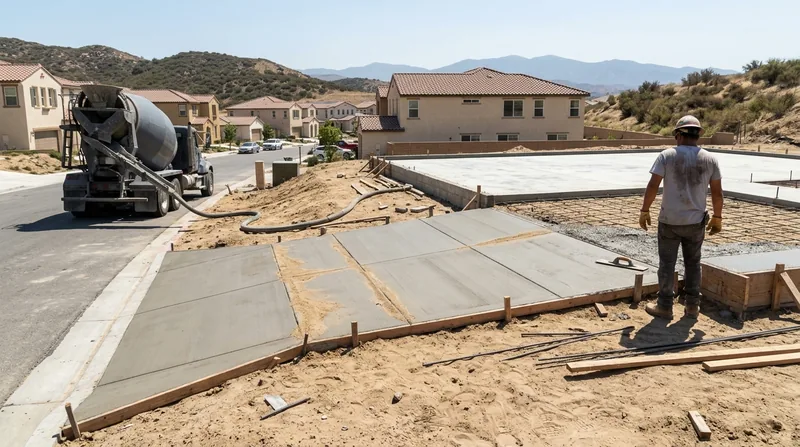




Concrete slabs and foundations in Santa Clarita demand precision, proper base preparation, and engineered reinforcement to survive the valley's unique soil and seismic conditions. Santa Clarita's terrain splits between sandy, gravelly alluvium along the Santa Clara River washes and graded cut-and-fill hillside pads where clayey soils swell and poorly compacted fill settles, causing slabs to crack and shift. The 1994 Northridge earthquake cracked driveways and foundations across the valley, proving that well-jointed, reinforced flatwork matters here. Whether you're adding a garage floor, pouring a shed foundation, or building a room addition in Stevenson Ranch, Valencia, or Old Town Newhall, your concrete must rest on a solid, properly compacted base and carry adequate steel to handle ground movement. We engineer every slab and footing to local soil conditions, install reinforcement that works, and compact the base to prevent future settlement and cracking.
Why Concrete Slabs and Foundations Matter in Santa Clarita's Shifting Soils
Santa Clarita sits on two very different ground types, each with its own failure mode. Alluvial soils near the river drain well but settle unevenly under load. Hillside pads, common in Stevenson Ranch and Plum Canyon, are graded fill over native clay that swells when wet and shrinks when dry. A slab poured without proper base compaction, adequate reinforcement, or control joints will crack within months. Seismic activity, seasonal moisture changes, and Santa Ana wind-driven temperature swings all stress concrete. The cost of fixing a cracked foundation years later far exceeds the cost of doing it right the first time.
- We compact the base to 95 percent of maximum density using field testing and equipment appropriate to soil type.
- We install steel reinforcement (rebar or wire mesh) at depths and spacing engineered for your specific load and soil class.
- We space control joints every 4 to 6 feet to direct cracks into planned locations and prevent random fracturing.
- We pour slabs at the correct thickness (4 to 6 inches for typical residential work, more for heavy loads) and finish them for proper drainage and safety.
- We cure concrete properly, protecting it from rapid drying and temperature shock during Santa Clarita's hot, dry summers.
A properly engineered slab or foundation outlasts decades of freeze-thaw cycles (rare here) and earthquake stress, protecting your structure and resale value.
Local reality: Hillside tracts in Fair Oaks Ranch and Sand Canyon often sit on deep fill over clay. A slab without proper base work and control joints will crack in the first year. We start with a soil engineer's report for complex sites.
For more detail on how settlement and seismic movement affect concrete, the U.S. Geological Survey's earthquake hazards page explains the regional seismic context.
How We Build Concrete Slabs and Foundations That Last in Santa Clarita
Our process starts with the ground, not the concrete. We visit the site, assess soil type and drainage, identify fill or native material, and determine whether additional site work (grading, compaction, or drainage) is needed. We then design the slab or footing for the load it will carry, the soil it will sit on, and local code requirements. Every pour follows a step-by-step sequence that controls timing, temperature, and finishing to prevent defects.
- We excavate to the correct depth, removing topsoil and loose material down to stable, compacted soil or engineered fill.
- We bring in gravel base material if needed and compact it in lifts using a vibratory plate or roller, verifying density with field tests.
- We set up forms, check elevation and slope for drainage, and install reinforcement (rebar or wire mesh) at the correct spacing and depth.
- We schedule the pour early in the day to avoid extreme heat, mix concrete to the right slump for workability, and place it continuously without cold joints.
- We strike off excess concrete, float and finish the surface for the intended use (smooth for a garage floor, broom-finish for slip resistance on walkways), and cut control joints while concrete is still green.
- We cover and mist the slab for 7 days to cure slowly and develop full strength, preventing rapid drying that causes surface cracking.
This methodical approach means your slab stays flat, strong, and crack-free for decades, even in Santa Clarita's seismic zone and variable soils.
Example: A garage addition in Castaic required a 24-by-24-foot slab on a hillside pad. We removed unstable fill, brought in engineered base material, compacted it to 95 percent density, installed 1/2-inch rebar on 12-inch centers, poured a 4.5-inch slab with proper slope, and cured it for a week. Two years later, zero cracks and no settlement.
Learn more about our garage floor concrete work or explore our concrete repair and resurfacing services if an existing slab needs correction.
Concrete Slab and Foundation Methods: Matching the Job to the Right Approach
| Approach | Description | Best For |
|---|---|---|
| Standard Poured Slab | 4 to 6 inch reinforced concrete on prepared base with control joints every 4-6 feet and proper finish for use. | Garage floors, shed foundations, room additions, and typical residential flatwork. |
| Thickened-Edge Slab | Standard slab with a thicker perimeter (8 to 12 inches) to support walls and carry heavier edge loads. | Structures with walls, crawlspace foundations, and additions where the edge bears significant weight. |
| Post-Tensioned Slab | High-strength steel cables tensioned after concrete hardens, creating internal compression that resists cracking. | Large spans, poor or expansive soils, and situations where crack control is critical (e.g., hillside pads in Plum Canyon). |
| Engineered Fill Slab | Slab on new or problem fill with soil testing, compaction verification, and drainage design to prevent settlement. | Hillside additions, sites with previous grading, and soils prone to expansion or settlement. |
| Shallow Footing | Reinforced concrete footing (typically 12 to 24 inches deep) designed to distribute wall or column load over stable soil. | Sheds, pergolas, pool equipment pads, and light structures where a full slab is not needed. |
Concrete Slabs and Foundations Cost in Santa Clarita: What to Expect
Concrete slab and foundation pricing in Santa Clarita typically starts at $5 to $8 per square foot for a standard residential pour on prepared, stable ground. A 400-square-foot garage slab might run $2,000 to $3,200 before any site prep. However, several factors move the cost up or down. Soil conditions are the biggest variable. Alluvial soils that drain well and compact easily cost less than hillside fill that requires extra compaction, testing, or drainage work. If we must remove and replace unstable fill, bring in engineered base material, or install a post-tensioned system for crack control, expect $10 to $15 per square foot or higher. Reinforcement type (wire mesh versus rebar, standard versus post-tensioned) and slab thickness also affect the total. Access and site logistics matter too. A tight lot in Valencia with limited equipment access costs more than an open site in Palmdale. Always get two to three written estimates before committing. A detailed estimate should itemize base prep, reinforcement, concrete volume, finishing, and any special work like drainage or fill removal. Visit our pricing overview for a full breakdown of typical costs and factors.
Concrete Slabs and Foundations Near Me: What Santa Clarita Homeowners Should Know When Hiring a Contractor
Finding a qualified concrete contractor near Santa Clarita means checking three essentials: insurance coverage, multiple estimates, and references from recent work. Insurance is non-negotiable. Your contractor must carry general liability insurance and workers compensation coverage to protect you if someone is injured or property is damaged on your site. Ask for a certificate of insurance and verify it covers the scope of work. Get written estimates from at least two contractors. A real estimate includes site assessment, soil conditions, reinforcement details, base prep, concrete volume, finishing method, and a timeline. Cheap estimates often hide corners that cost you later (poor compaction, thin base, inadequate reinforcement). Check references. Ask the contractor for the names and phone numbers of three homeowners from the past year who had similar work done. Call them and ask if the job stayed on schedule, the finish quality met expectations, and the contractor cleaned up properly. For any work near property lines, existing utilities, or in an HOA community, confirm that the contractor understands local permit requirements and can handle permitting and inspections. Contact us for a free, no-obligation estimate and references from Santa Clarita, Stevenson Ranch, and nearby communities.
Hiring tip: Santa Clarita and surrounding areas require permits for driveway and sidewalk work, curb cuts, and any work in the right-of-way. A contractor who knows local code and can pull permits saves you time and headaches. Ask whether permitting is included in the estimate or billed separately.
Concrete Slabs & Foundations in Santa Clarita: Pricing Guide
| Service | Price | Details |
|---|---|---|
| Standard residential slab on stable ground | Starting at $5/sq ft | 4 to 6 inch reinforced concrete with proper base, control joints, and finish; includes excavation and compaction of existing soil |
| Slab with extra base prep or fill replacement | Starting at $8/sq ft | Includes removal of unstable material, engineered fill, compaction verification, and drainage work typical of hillside sites in Santa Clarita |
| Post-tensioned or thickened-edge slab | Starting at $10/sq ft | High-strength reinforcement, specialized finishing, and engineering for expansive soils or heavy loads; common in Stevenson Ranch and Plum Canyon |
| Shallow footing for structures or pads | Starting at $12/sq ft | 12 to 24 inch deep reinforced footing for sheds, pergolas, or pool equipment; pricing varies by depth and soil conditions |
| Site assessment and estimate | Free | No-obligation visit to evaluate soil, drainage, existing conditions, and provide a detailed written quote within 24 hours |
| Travel within Santa Clarita and surrounding areas | Included | No separate mileage fee or travel charge for estimates and work in Santa Clarita, Stevenson Ranch, Castaic, Palmdale, Lancaster, and nearby cities |
Indicative pricing, the exact cost depends on square footage, finish, and site access. Free personalized estimate within 24h at (661) 528-6456.


